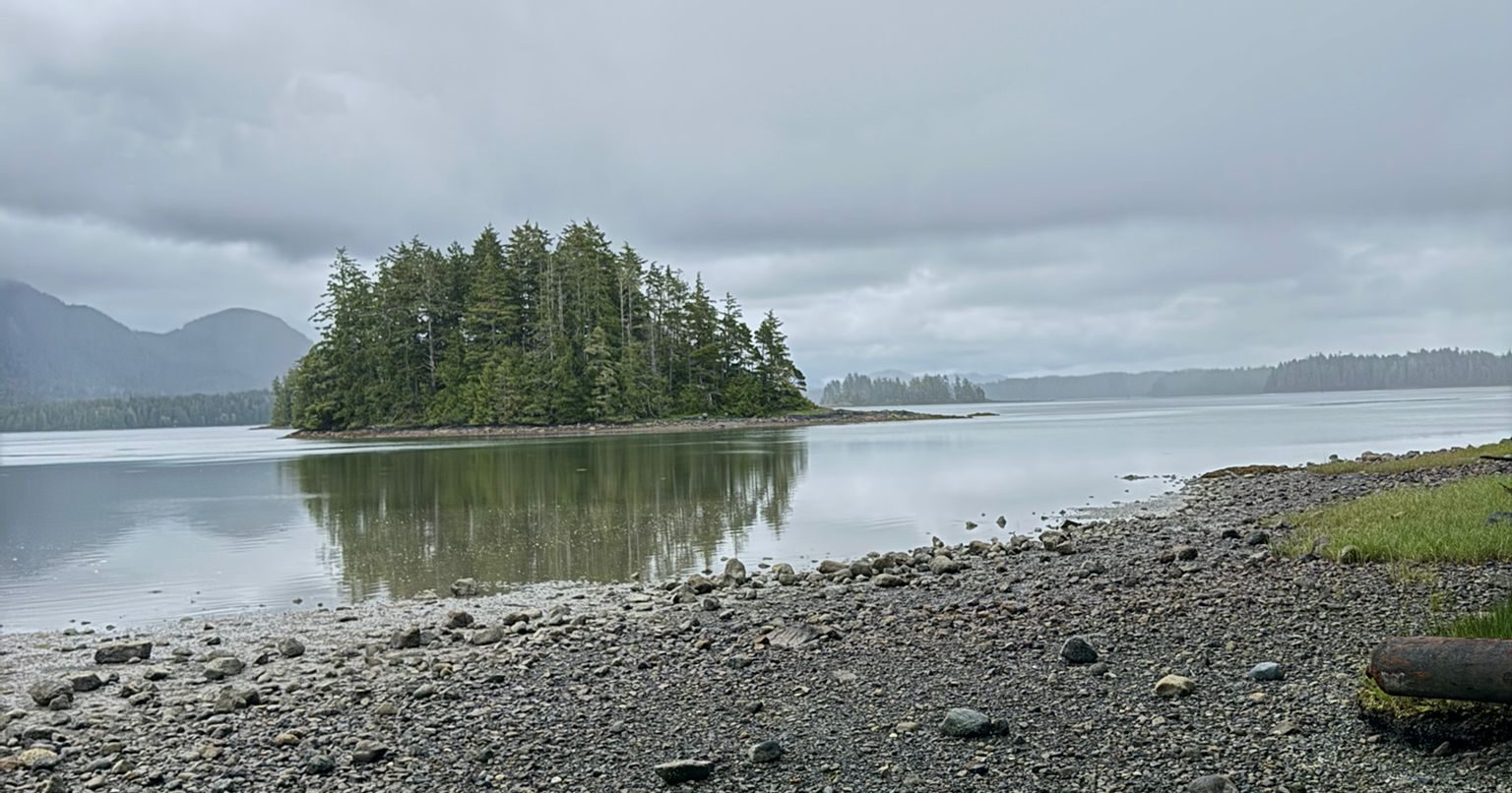
Photo: Unceded traditional territory (Ha’huulthii) of the Tla-o-qui-aht First Nation. Submitted by Chelsea Martin, RAD Network.
Canada’s Nature Strategy Requires Indigenous Leadership
June 2026
The success of Canada’s new nature strategy depends on Indigenous leadership. Indigenous-led nature-based solutions offer a critical pathway for advancing both economic and climate resilience and will be critical to the achievement of Canada’s 30×30 conservation goals.
This Spring, the Mark Carney government announced A Force of Nature: Canada’s Strategy to Protect Nature, outlining how Canada will deliver on its 2030 Nature Strategy.
The strategy arrives at a pivotal moment. As the climate and biodiversity crises intensify and the 2030 deadline approaches, Canada faces increasing pressure to meet the commitments it made under the Kunming-Montreal Global Biodiversity Framework, including protecting and conserving 30 percent of lands and waters by 2030 (the “30×30” target).
To support this goal, the federal government has committed $3.8 billion over four years, including $1.6 billion dedicated to Indigenous-led conservation. This investment recognizes what Indigenous Peoples have long demonstrated: that Indigenous stewardship, governance, and knowledge systems are essential to protecting biodiversity and sustaining healthy ecosystems.
As a network focused on Indigenous-led regenerative economies, RAD Network welcomes the strategy’s recognition of Indigenous leadership and its growing focus on innovative conservation finance mechanisms alongside traditional protected areas. We are encouraged by the attention given to both nature-based solutions (NbS) and Indigenous-led conservation.
Through our work with Indigenous Nations across Canada, RAD consistently hears the same message: Nations are ready to advance stewardship, conservation, restoration, and carbon projects in their territories. The challenge is not a lack of ambition or opportunity. The challenge is the policy frameworks, financing systems, and jurisdictional barriers that were not designed to support Indigenous authority. Realizing the full potential of these innovative approaches will require policies and funding programs that place Indigenous rights, jurisdiction, and leadership at their core.
Centering Indigenous Rights and Unlocking 30×30
Canada will not achieve its 30×30 commitments without Indigenous leadership. Across the country, Indigenous Nations are already stewarding some of the most biodiverse and carbon-rich landscapes on Earth. Yet many of the projects that could simultaneously advance conservation, climate action, and economic development remain stalled by jurisdictional and policy barriers. Canada’s new Nature Strategy is an important step forward, but its success will depend on whether Indigenous rights, governance, and leadership are truly placed at the centre of implementation.
To better align Canada’s biodiversity and climate objectives requires integrating nature-based solutions into federal carbon market frameworks in alignment with Indigenous rights and authority. We know that, across the country, Indigenous territories overlap with high biodiversity areas and carbon sinks. Supporting Indigenous-led projects can help advance both conservation and climate goals while creating long-term economic opportunities for Indigenous Nations.
Meeting Canada’s goal of protecting 30% of lands and waters by 2030 will not be easy. While roughly 15% is already protected, achieving the remaining 15% will be significantly more challenging, as many of the most straightforward conservation opportunities have already been realized. Reaching the 30×30 target will require new approaches, partnerships, and investments and will not be possible without Indigenous leadership. Translating the vision to action on the ground will require significant investment in capacity building and coordinated effort to remove barriers for Indigenous leadership.
From coast to coast to coast, Indigenous Nations have carbon and stewardship projects ready to advance in their territories. The feasibility and climate benefits are clear; rather, it is jurisdictional barriers blocking these projects from moving forward. Respect for Indigenous rights and authority will be critical to our collective path forwards.
Strengths & Opportunities for Indigenous Nations
- Recognition of Indigenous leadership: The strategy recognized Indigenous leadership as essential to achieving Canada’s 30×30 conservation targets
- Increased Funding & Support: The strategy includes funding for Indigenous-led stewardship, expansion of Indigenous Guardian programs and stated support for Indigenous Protected and Conserved Areas (IPCAs)
- Other Effective Area-Based Conservation Measures (OECMs): The proposed pathway to 30×30 would see the expansion of OECMs (8% of the 30% target). Some Nations see OECMs as an opportunity to define conservation outside traditional protected area frameworks and federal/provincial relationships. The federal government also hasn’t defined OCEMs, presenting an opportunity for Nations to shape criteria.
- Project Finance for Permanence (PFPs): The strategy indicated new long-term conservation financing partnerships with Indigenous governments providing sustainable funding beyond political cycles
- Water Security Strategy: The first National Water Security Strategy is being developed with Indigenous partners through Canada Water Agency
Risks and Concerns
- IPCAs conspicuously absent: While Indigenous Protected and Conserved Areas (IPCAs) are named as a general priority, they are not explicitly named in terrestrial breakdown despite 150+ declared IPCAs across Canada, with the exception of the Seal River IPCA which was already in motion
- Expert Task Force on Nature Capital: An Expert Task Force on Nature Capital and Financing is being launched, which could pose an opportunity or a major risk depending whether Indigenous voices are adequately represented
- Role of provinces and territories: The proposed strategy may be impeded by provincial legislation and policies that are contrary to nature protection strategies, and which in many cases created barriers for Indigenous-led stewardship and conservation more broadly
- Focus on OECMs: While the strategy’s focus on OCEMs may present opportunities (noted above), the lack of a clarity around the criteria/definition poses a risk if Indigenous Nations are sidelined from the conversation
- Potential misalignment with major projects legislation: Proposed reforms to accelerate major project approvals may weaken environmental protections and threaten Indigenous sovereignty. On the flipside of the risk is an opportunity to prioritize Indigenous-led nature-based solutions to advance climate, conservation and economic goals.
-
What’s Needed for Success
Canada’s Nature Strategy can only succeed if implementation:
- recognizes Indigenous governments as decision-makers, not stakeholders;
- invests in long-term Indigenous stewardship capacity;
- supports Indigenous-led conservation finance and carbon market participation;
- advances IPCAs as a central pathway to 30×30;
- ensures Indigenous leadership within federal advisory and financing structures;
- aligns biodiversity, climate, economic development, and reconciliation objectives rather than treating them as separate policy streams.
Major Projects & Indigenous-led Nature-based Solutions
The new nature strategy comes against the backdrop of a broader policy focus on major projects, economic growth and trade competitiveness. While significant emphasis has been placed on attracting investment and accelerating development, less attention has been given to how these investments will build long-term resilience for communities and workers. Proposed legislative changes to accelerate major project approvals raise questions about how Canada will uphold its nature commitments while weakening environmental safeguards.
With respect to Indigenous sovereignty, the proposed reforms also raise concerns as to whether the federal government will continue to uphold its constitutional duty to consult and accommodate Indigenous Peoples under Section 35 of the Constitution, while also honouring its commitments to Free, Prior and Informed Consent (FPIC) under UNDRIP and honouring reconciliation promises.
At the same time, Indigenous-led nature-based solutions offer a critical pathway for advancing both economic and climate resilience. Rather than being treated as a separate environmental agenda, they are foundational economic infrastructure. The conversation should not be framed as nature versus development, but rather what kinds of projects Canada chooses to prioritize. Indigenous-led nature-based solutions are themselves nation-building investments that create jobs, strengthen stewardship capacity, protect biodiversity, and deliver long-term economic benefits.
If Canada is serious about building a resilient economy, Indigenous-led conservation and restoration initiatives should be recognized as strategic infrastructure investments alongside transportation, energy, and resource projects. Indigenous Nations are not simply participants in conservation—they are leaders in shaping Canada’s environmental and economic future.
If implemented with Indigenous leadership at its core, Canada’s Nature Strategy could become more than a conservation plan. It could become a roadmap for advancing biodiversity, climate resilience, economic prosperity, and reconciliation together.
Stay tuned as for RAD Network’s response to the discussion paper Getting Major Projects Built in Canada and consider submitting your own response. Read the proposal and email your feedback to engagement@pco-bcp.gc.ca by July 22, 2026.