Indigenous Learning & Knowledge Hub
In Spring 2024, RAD Network launched an Indigenous Learning and Knowledge Hub to advance the knowledge systems, governance responsibilities and economic priorities of Indigenous communities in Nature-based Solutions across Turtle Island.
The hub is funded by Environment and Climate Change Canada as part of a large multi-hub research grant to support Natural Climate Solutions learning and knowledge mobilization.
The Hub strengthens our ability to advance Indigenous-led nature-based solutions with Nations, communities and partners across Canada. The funding allows us to deepen our work in removing barriers and supporting Indigenous Nations in conservation efforts, and fostering ethical collaborations that uphold Indigenous rights and responsibilities as the field of nature finance and natural climate solutions grows. Acknowledging the underlying inequities and history of colonial land relations, nature-based solutions in Canada must be done with the full participation of Indigenous peoples in a way that recognizes their sovereignty and inherent rights and responsibilities, in accordance with UNDRIP, the Constitution, and Natural Law. Through the Hub, we are deepening our work as a catalyst for change—expanding capacity, mobilizing knowledge, and ensuring Indigenous leadership remains central to climate and conservation solutions. Click here to watch the Hub Launch Webinar recording and connect to find out how we can collaborate!
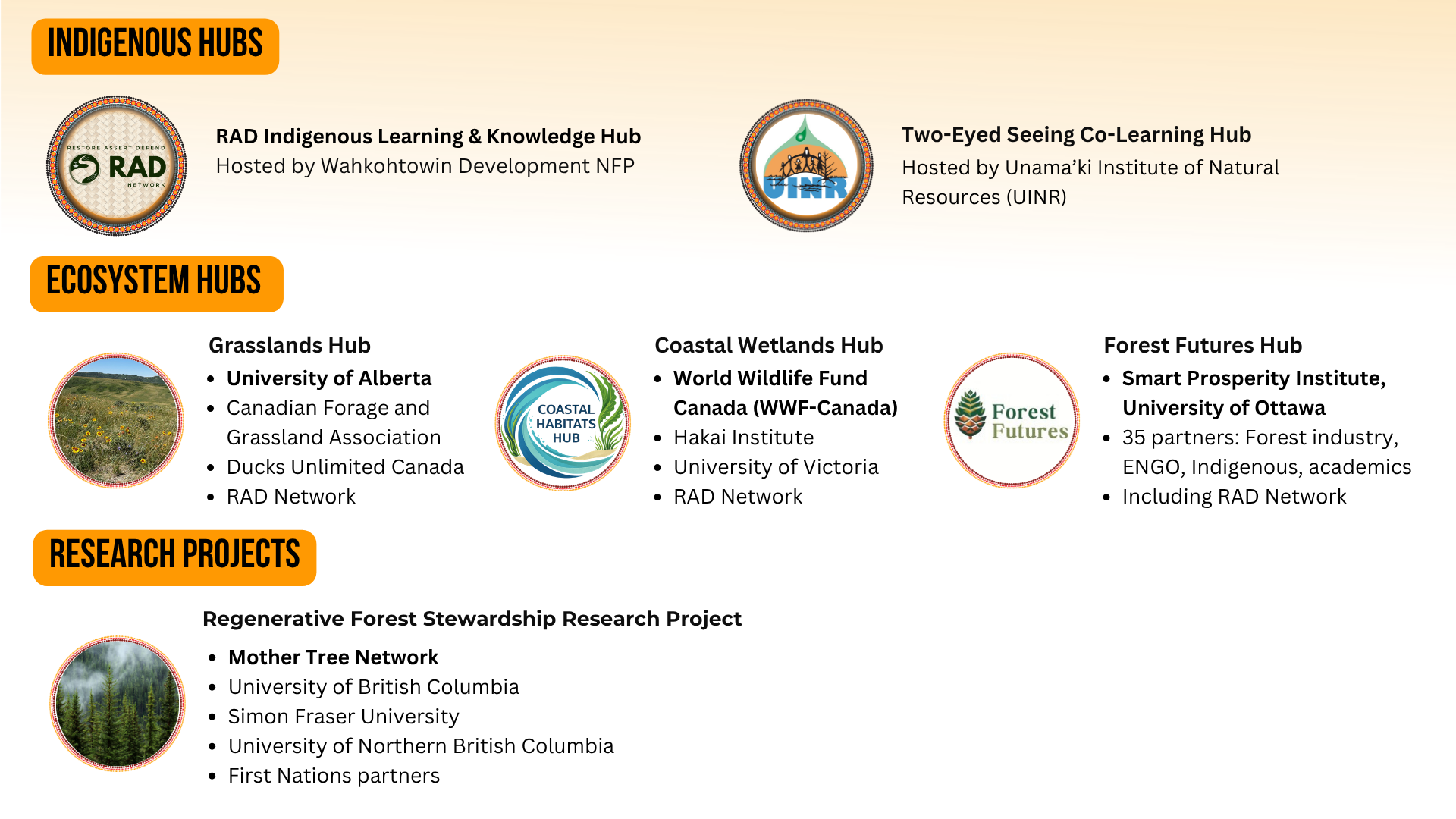
Alongside the Hub hosted by RAD Network, the ECCC funding has supported the creation of the Two-Eyed Seeing Co-Learning Hub, as well as ecosystem-specific Learning and Knowledge Hubs focused on Grasslands, Forests and Coastal Habitats. As a project partner, RAD is woven across the hubs to ensure cross-connectivity and will be supporting learning and development around Ethical Space within the ecosystem hubs.
Two-Eyed Seeing Co-Learning Hub
The Unama’ki Institute of Natural Resources (UINR) is hosting the Two-Eyed Seeing Co-Learning Hub. This project is an exploration of UINR’s Two-Eyed Seeing learning journey, to support other Indigenous-led nature-based solutions throughout Canada. The Hub involves research and community-partner engagement, all of which is guided by Two-Eyed Seeing AND will help other organizations to better align with Two-Eyed Seeing.
We are excited to collaborate with UINR on this important work, including by supporting cross-hub connectivity, helping to mobilize Two-Eyed Seeing wise practices, and aligning our efforts to elevate Indigenous-led nature-based solutions.
- UINR website: https://www.uinr.ca/
- UINR Instagram: https://www.instagram.com/uinr/
Grasslands Learning & Knowledge Hub
Grassland loss in Canada is an issue of environmental, cultural, economic and social concern. The Grassland Learning and Knowledge Hub is hosted at the University of Alberta and includes RAD Network, the Canadian Forage and Grassland Association, and Ducks Unlimited Canada. The Hub’s mission is “to increase foundational knowledge and capacity to support widespread understanding and implementation of natural climate solutions in Canadian grasslands while maximizing the co-benefits for biodiversity and human well-being”.
The Hub’s strategy focuses on three key research pillars including Economics, Human Dimensions and Policy, with three cross-cutting pillars for a Community of Innovation, Learning and Knowledge Transfer, and Indigenous Engagement. A key pathway through which RAD engages with the Grasslands Hub is through the Indigenous Subgroup, where we’re working to advance the Hub’s needs and learning development in right relations and ethical engagement.
- Click here to sign up for the Grasslands Hub mailing list.
- Website: www.ualberta.ca/en/grassland-learning-knowledge-hub
- Podcast: Forage and Grasslands Unpacked
- Contact: augglkh@ualberta.ca
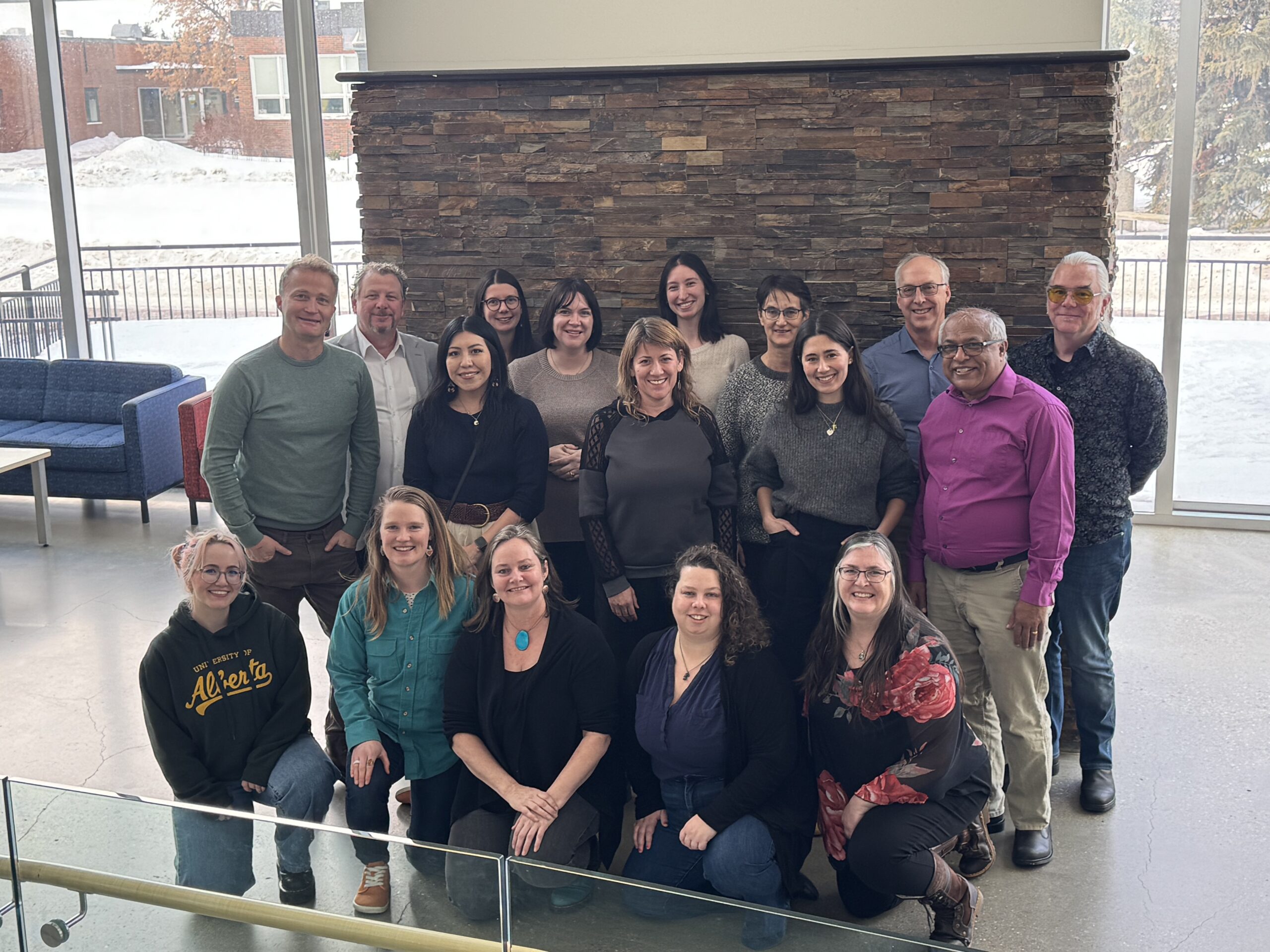
Image: Grasslands Learning & Knowledge Hub team at the Augustana Faculty, January 2025. Note that several participants are absent from the photo.
Coastal Habitats Hub
RAD Network partners with the Coastal Habitats Learning and Knowledge Hub to co-create pathways for collaboration that centre Ethical Space and elevate Indigenous voices, worldviews, laws, and research priorities. The Coastal Habitats Hub is a national initiative co-led by WWF-Canada and the Hakai Institute, in partnership with the RAD Network, McGill University and the University of Victoria. Spanning three coasts and three habitats (salt marshes, seagrass, and kelp forests), the Hub aims to synthesize and share knowledge, enable and support people, and advance actions to address climate change.
- Mailing List Sign-Up: https://mailchi.mp/hakai/coastalhabitatshub
- Contact: bluecarbon@wwfcanada.org